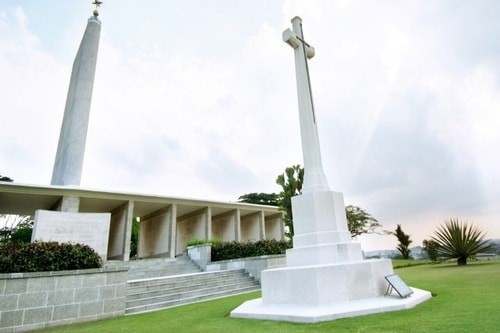
The Kranji War Memorial (Chinese: alive; Malay: Tanah Perkuburan Perang Kranji) is situated on 9 Woodlands Road, north of Singapore in Kranji. Dedicated to the men and women of the United Kingdom, Australia, Canada, Sri Lanka, India, Malaya, the Netherlands and New Zealand who died defending Singapore and Malaya against the invading Japanese forces during World War II, it includes the War Graves, the Memorial Walls, the State Cemetery and the Military Graves.
This is one of Singapore’s most popular historic sites. The Kranji War Memorial is one of Singapore’s historical sites. It honors those murdered in the duty line during the Second World War. It also has a mass grave of 69 Chinese troops who died during Singapore’s Japanese occupation. It looks hauntingly peaceful over 4,400 white gravestones. A enormous commemoration is also held every year on the Sunday nearest to November 11.
The War Memorial reflects the military’s three branches–the Air Force, Army, and Navy. The columns depict the Army marching in rows, the cover over the columns is formed after a plane’s wings, representing the Air Force, and the top shape resembles a submarine’s sail, representing the Navy.
The walls of the Memorial inscribe more than 24,000 names of allied staff whose bodies have never been discovered, spread across both sides of the war memorial’s 12 columns themselves. The names of 191 Canadian airmen are registered on the Kranji War Memorial.
The memorial grounds are set on a hilly terrain. The grounds are maintained by the Commonwealth War Graves Commission and are only accessible from Woodlands Road, the same road that the Japanese 25th Army’s Imperial Guards Division marched down on February 9, 1942.
The War Graves Photographic Project in connection with the Commonwealth War Graves Commission included Kranji War Memorial and Cemetery in the research archive. With each and every column on the monuments, each individual grave was registered.
The War Cemetery is the final resting place on maintained and manicured lawns for 4,458 Allied soldiers in labeled tombs set out in rows. More than 850 of these tombs are unknown. To the northern end of the cemetery grounds is the State Cemetery, where Singapore’s first and second presidents Yusof bin Ishak and Benjamin Henry Sheares are buried. To the east are the Commonwealth soldiers ‘ Military Graves who died in the Konfrontasi and Malayan emergencies. The Chinese Memorial buried 69 Chinese servants who served as representatives of the Commonwealth forces and were murdered by the Japanese in February 1942.
There are also 64 burials for the First World War, including unique monuments for three men buried in civil cemeteries in Singapore and Saigon, whose tombs have been difficult to find until this day.
Previously a burial ground in the hospital during Singapore’s Japanese occupation, it became at the end of the war a military cemetery. The monument was exhumed and reburied by military personnel buried elsewhere in Singapore. On the memorial walls were engraved the names of Indian soldiers as they had already been cremated, as is usual in Hinduism.
The History Behind Kranji War Memorials
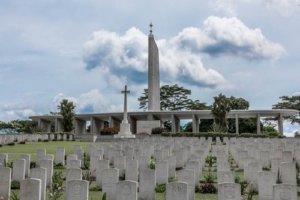
The Kranji region was a military camp before 1939 and it was the site of a big ammunition magazine at the moment of the Japanese invasion of Malaya. The Japanese crossed the Johore Straits in force on February 8, 1942, landing at the Kranji River mouth two miles from where the war cemetery is now located. They initiated an assault between the river and the bridge on the afternoon of February 9. Over the next few days, fierce fighting took place, in many cases hand-to-hand, until a withdrawal was necessary for their much superior numbers and air strength. After the reoccupation of Singapore, when it became evident that a larger cemetery at Changi could not remain undisturbed, the small cemetery started by the prisoners at Kranji was developed into a permanent war cemetery by the Army Graves Service. Changi was the site of the primary prisoner of war camp in Singapore, and the Australian Infantry Force had established a big hospital there. The tombs were moved from Changi to Kranji in 1946, as were those from the war camp prisoner Buona Vista. Many other tombs from all parts of the island were transferred to Kranji along with all the tombs from the Saigon Military Cemetery in French Indo-China (now Vietnam), another site where permanent maintenance could not be guaranteed. The Commission later carried both World Wars tombs from Bidadari Christian Cemetery, Singapore, where it was no longer feasible to maintain permanently. At KRANJI WAR CEMETERY there are now 4,461 Commonwealth casualties buried or commemorated in the Second World War. Over 850 of the burials are unidentified.
The Chinese Memorial in Plot 44 marks a collective grave for 69 Chinese servants, all Commonwealth forces members, who were killed by the Japanese during the February 1942 occupation. Burials and commemorations number 64 of the First World War, including unique monuments to three victims known to have been buried in civil cemeteries in Saigon and Singapore, but whose tombs could not be situated. The SINGAPORE MEMORIAL stands inside Kranji War Cemetery, bearing the names of more than 24,000 Commonwealth land and air forces known to have no tomb. Many of these have no known date of death and the date or period from which they were known to have been missing or caught is granted in our documents. The land forces recognized by the monument died during the campaigns in Malaya and Indonesia or subsequently in jail, many of them during the building of the Burma-Thailand railway or at sea while being transported elsewhere to jail. The monument also honors servicemen who died throughout Southern and Eastern Asia and the adjacent seas and oceans during activities.
The SINGAPORE (UNMAINTAINABLE GRAVES) MEMORIAL, located at the western end of the Singapore Memorial, honors more than 250 victims who died in campaigns in Singapore and Malaya, whose well-known tombs in civil cemeteries could not be maintained and could not be relocated to a war cemetery on religious grounds. The MEMORIAL SINGAPORE CREMATION, which stands instantly behind the Singapore Memorial, commemorates nearly 800 deaths, mostly from the Indian armies, whose bodies were cremated according to their religious convictions. At the eastern end of the Singapore Memorial stands the SINGAPORE CIVIL HOSPITAL GRAVE MEMORIAL. Hundreds of injured civilians and soldiers captured by the Japanese were brought to the hospital during the last hours of the Battle of Singapore. The amount of deaths was such that burial was impossible in the ordinary way. Before the war, an emergency water tank was dug into the hospital’s grounds and used as a grave for over 400 civilians and Commonwealth servants.
After the war, it was decided that it would be impossible to identify the dead individually, leaving the grave undisturbed. The tomb was appropriately enclosed, consecrated by the Bishop of Singapore, and the military authorities erected a cross in memory of all those buried there. The Singapore Civil Hospital Grave Memorial commemorates the 107 Commonwealth deaths buried in the grave. Colin St. Clair Oakes built the Kranji War Cemetery and the Singapore Memorial. The adjacent Kranji War Cemetery is the KRANJI MILITARY CEMETERY, a significant non-world war site of 1,422 burials, established in 1975 when it was discovered necessary to remove the sepulchers and their relatives from the cemeteries of Pasir Panjang and Ulu Pandan.
Kranji War Cemetery is located 22 kilometers south of Singapore City, on Singapore Island’s northern side overlooking Johore Straits. It is situated on Woodlands Road just west of Singapore-Johore Road (Bukit Timah Expressway), just south of the Turf Club Avenue and Kranji Road crossroads. From the primary street there is a brief approach path. Locally known as the Kranji Memorial, the Cemetery must be sure of the address before boarding a taxi as most taxi drivers don’t understand the Cemetery.
There are also bus stops in front of the cemetery on the primary highway. The Kranji MRT (train) terminal is about a 10-15 minute walk away from the Cemetery. A prior visitor has recommended us to obtain from the MRT ticket office a tiny map of the path.
Opening Hours: Daily 7.00am – 18.30pm
Email: enquiries@cwgc.org
Contact Number: +44 1628 634221
How to go to Kranji War Memorial in Singapore?

Our main service is to provide the private taxi services for travelers who travelling between Singapore to JB (Johor Bahru) Malaysia. We are also accept the reservation from Johor to Singapore. We will make sure that you have a very comfortable and pleasant experience.
In addtion, there are many attractive places in JB. Popular places of interests include Johor Bahru’s shopping district Jalan Wong Ah Fook consists of various legend cafes and culture street.
You can hire private taxi as your transport to jb because it is very convenient and comfortable. You might not familiar with the road and getting lost while travel. SG2JB provides transport to jb at affordable rate. We can pick you up from singapore to johor bahru without any hassle.
If you are looking for private taxi to jb or taxi to sg or transport to jb, don’t hesitate to contact us for your transportation from singapore to jb/singapore to johor/johor bahru to singapore.